
Clean Slate
how do we move forward with so much garbage in the way?

It’s an obsession.
I think about the Church all the time.
I listen to sermons online. I collect and read books. I follow podcasts. I go to conferences, workshops and meetings.
I talk about the Church with anyone who will talk with me about the Church.
Recently a friend sent me a notice from which I’m going to share a paragraph with you. It’s from a call for papers by a periodical that is asking everyone to think about the Church and offers questions we might consider answering in papers we submit.
Here’s part of the note…
“In the next issue … we seek theologically-infused contributions on these themes of church. The following are some—but certainly not all—of the questions authors might wish to consider: What is the church? How can it be identified in the world? What are the most important and pressing roles and tasks of the church? What are we to make of the church’s harms, failures, and abuses? What is the role of the church in society today, and how ought we think of the broader church’s declining numbers? What in our ecclesiologies needs to be rethought and reimagined to facilitate flourishing in this next chapter of its existence? What are the relations between the church as an institution with administrative responsibilities and the community of believers? In what ways is Christ present—or not—in and as the church by way of the Spirit’s working? How ought we think about the work and responsibilities of the church in a pluralistic society? What holds together the various strands of Christian expression across diverse religious communities? How should we understand the difference between political participation and the church? Why are certain parts of the church—namely Evangelical megachurches—witnessing the most growth while other churches are seeing rapid decline in attendance?”
These are the things I think about all the time.
All.
The.
Time.
If you’ve ever seen me sitting and staring off into the distance, I was probably thinking about one of these questions.
Or all of them at once.
I acknowledge that I have a problem.
This call for papers encourages me. It means there are a bunch of other people who are just as obsessed as I am. Their preoccupation may not be healthy either, but it means I’m not alone.
And that gives me hope.
The last decade of life in the evangelical churchworld has been the most challenging 10 year stretch in my 40 years of following Jesus. I’ve been through church splits, planting a couple churches, abusive leadership, abusive congregations, worship wars, and shifts in theology that included embracing all the gifts of the Spirit and believing that women can and should be leaders in the Church just the same as men. I’ve lost friends because I decided sprinkled people can be saved alongside immersed people and that tongues – rather than a sign of demon possession – can be a beautiful way to pray.
But it’s only in the last few years that the weight of disappointment in the actions and attitude of the evangelical church and the convoluted mess we’ve become have me feeling like there’s only one way forward.
Burn it all down.
I used to deliver drugs for a living. The legal kind that was obtained with a doctor’s prescription. I delivered to people in every imaginable situation of life. On the same day I delivered to a retired doctor in a mansion in an area of town we called Snob Hill, I also delivered to a naked man living in a shack with walls that let in sunlight and in front of which was an actual mote which I had to traverse, slowly across a long 2X4, to deliver his prescription. Once a month I delivered to a woman who sat in the center of a room 3 feet from a television, surrounded by garbage. She was a hoarder. There was a narrow path along which the cockroaches would scurry to escort me from the front door to her, and her chair. She never got up. I thought many times about returning to her little living space that was filled floor to wall to ceiling with garbage to bring a group to clean things up, but the overwhelming nature of the task made me feel like the only reasonable hope of giving her a fresh start was a hard but simple choice.
Burn it all down.
That probably sounds crazy to most people, especially regarding the Church.
What’s so bad that a little Reformation couldn’t fix it?
What’s so terrible that a touch of Revival can’t sort it all out?
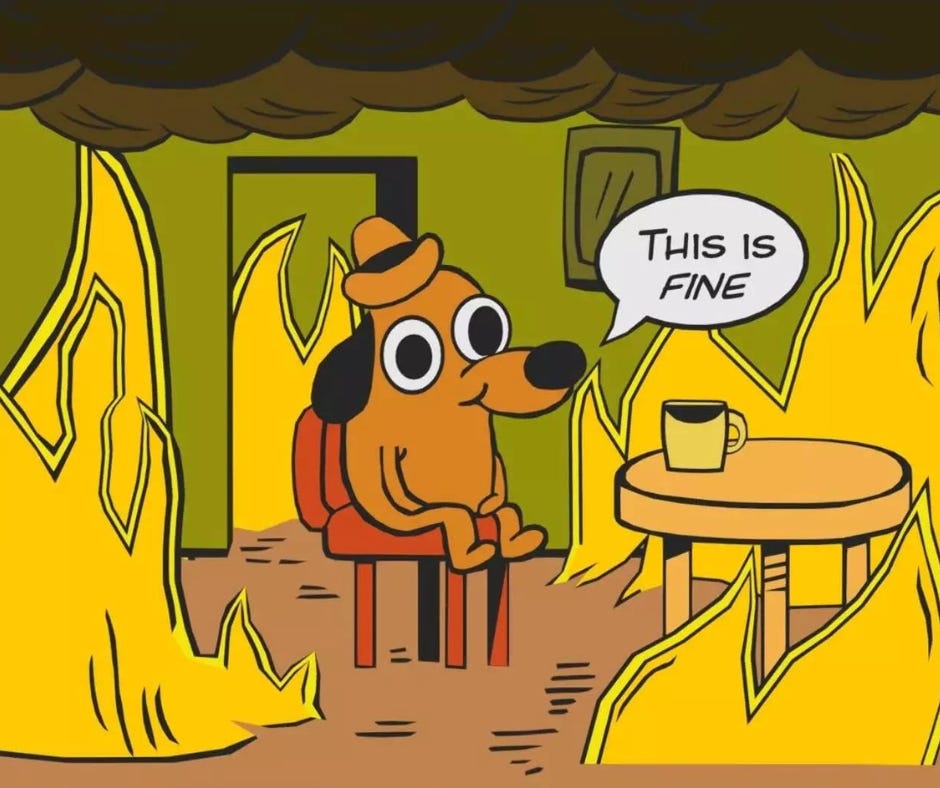
I won’t make a list of all the garbage I see. I’ll just say that sometimes I feel like we’ve become the lady in the center of the room. Entropy has gripped our souls. We are psychically and emotionally so overwhelmed at the amount of work required to set things right that we feel paralyzed. And we just go along to get along. We just accept what is as inevitable, or the best we can do, or as good as it gets. Or maybe we identify with the little dog in the “This is fine” meme, sitting at the table with his coffee, surrounded by flames, in a smoke-filled room saying to himself, “This is fine.” We’re living in spiritual shock.
There’s a preacher in California I like to listen to. Other than his accent, he’s not unique. He is working very hard to make his modest size church into the next big thing. He has a load of money to work with and can fill the local church with enough interns and staff to create the impression more and more people are coming. When he preaches, he has the recurring theme of repentance. No matter what he’s preaching about, the underlying theme is that God wants to do great things, big things, huge things with their church but the sins of the people and their lack of zeal for the house of the Lord keeps getting in God’s way. If everyone would just repent and get their shit together, God could do something amazing. (he doesn’t actually say “shit,” just fyi)
There are a ton of problems with that way of thinking.
And acting.
And, frankly, being.
But the one thing I want to mention here is that the focus is always on people and never on systems.
Never on the powers and the principalities.
The focus is always on the one thing we don’t wrestle with, and the tendency is to ignore that which is warring against our souls.
aka, sucking the life out of us.
It’s the churchworld system that we’ve built. The presuppositions. The imposition of the American dream onto the Beloved community. The swap of the “one anothers” for consumerism. It’s our willingness to give up a birthright for a quick hit. We sell character but we will only pay for results.
And what I’m coming to believe is that maybe what we need isn’t gas and a match. Maybe I’m way off base with “burn it down.” Maybe what we need are better questions and a willingness to answer them. Maybe instead of a fire, what we need is a clean slate. Maybe the future is in conversations that are honest and open and patient and loving and vulnerable and less centered on dominant personalities and more on collective, consensual discernment.
But people in power tend to use their power to stay in power (or keep their power).
In Bible College, a professor led our class on a simple thought experiment. He asked us to imagine that our whole class had been in a plane together passing over a remote location. A deserted island maybe. The plane crashed and we all survived but realizing it could be a long time before we were found, we had to construct a society, a way of living together and that would include church. He asked us to list essentials. What do we need to have and to be and to do to call it “church?”
And as the class started tearing into one another about what was “essential” I wondered if the professor had ever read Lord of the Flies.
Eventually the prof had to step in. The strongest personalities were polarizing the whole class. Later I would come to recognize this as a classic board meeting vibe in the denomination of which I was a part. At the time, as an introvert, I just opened my briefcase, put it on my desk and hid behind the lid.
The professor, one by one, erased our answers from the board until there were only seven things left.
And I’m wondering what seven things you imagine were left on that board. I’m also thinking that what is needed in the conversation about the Church is more eraser and less “burn it down.” And I think I want to try a thought experiment with you.
Imagine everything we call Church is erased and you are tasked with describing what is essential. That which is necessary. That which is required to call something “the Church.” What seven things are on your list? Can you do it, to your satisfaction, with less? Do you have to have more than seven to create a list that satisfies your soul?
I’m going to be working on answering the questions posed by the call for papers and I want to invite you to come along with me and help shape those answers. Maybe together we can erase and together reimagine a way forward that doesn’t require the fire.
I think that putting down the construct of religion and sincerely asking, "what would love do?", would create a paradigmatic change in action that we are looking for.
I like Jurgen Habermas' distinction between the "right" and the "good." The right in Habermas is treating people justly. So the government has the obligation to do right by its citizens by providing goods and services in a just manner. The good is our communal vision of what the good life looks like. Churches help people nurture and grow into their vision for the good life. We generally think this involves communion with God and one another.