
Essentials
when do our adaptations make it a form that's lost it's soul?

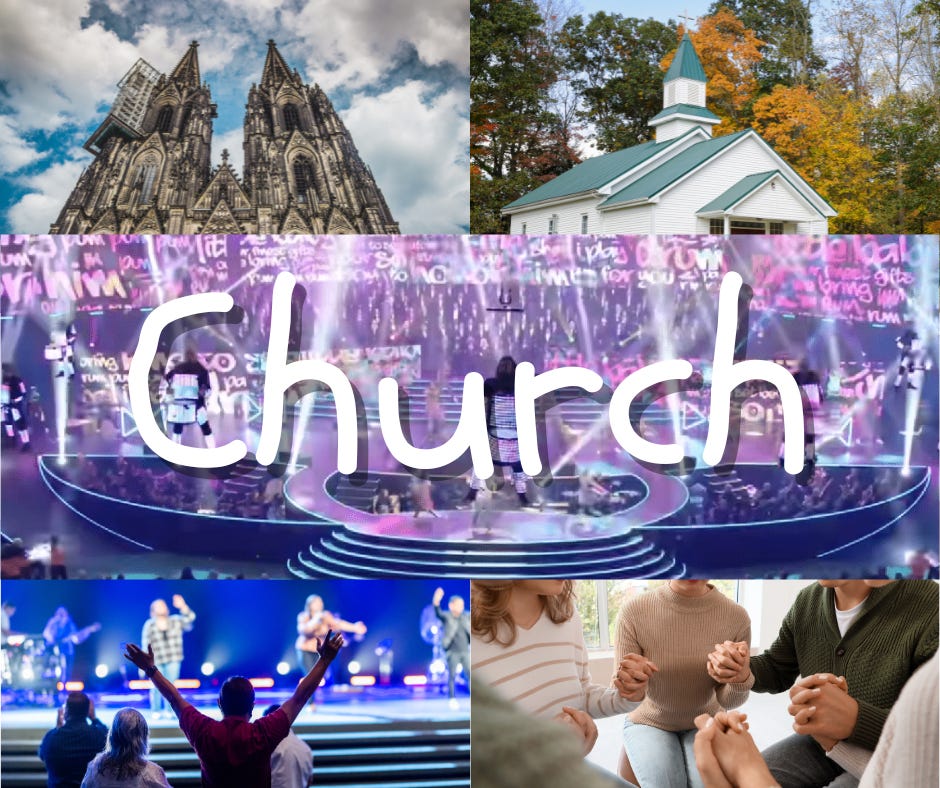
It was a thought experiment.
The course was called, New Testament Church, and we were asked to come up with a list of the “required things,” the essential ingredients for something to be legitimately called a “church” in the sense used by the New Testament writers.
What would you put on your list?
Building?
Stage?
Band?
Preacher?
Children’s Ministry?
Chairs?
Smoke machine?
Baptism tank?
A Bible?
Elders?
It was similar in nature to another thought experiment I would be given on a course for worship leaders and band members. What were the necessary elements to be able to call what we were doing as the saints assembled, “worship?”
What would you put on that list?
In the New Testament Church course, a heated debate developed among our class. Even though we were all hardcore churchgoers, we didn’t – and seemingly couldn’t - all agree with each other on what the indispensable elements of “church” were. Eventually our professor boiled all our ideas down into just a few descriptors of what makes a church, a church. And then he gave us his own list of seven ‘essential’ things.
Over the last 40 years, I’ve read books and articles, listened to lectures and podcasts, taken courses and been in discussion groups that have all engaged in this same thought experiment, that all tried to answer the same question.
In March 2024, Dr. Scot McKnight was reflecting on Bonhoeffer’s book, Life Together, and wrote on his Substack, “Until we understand what the church is — a fellowship of sinners at different locations on a journey — we will not understand what the church could be and can be. No two Christians are perfectly compatible — in theology or praxis — and therefore there will be tension in the church, which is precisely where we need to begin to see what the church is. Not a fellowship of those who agree or who are alike but a fellowship of those who don’t agree and who are not alike. When we demand the church be like us, or like our vision for what it is, or we leave church altogether, we create our own church — and eventually (if we have the guts) we start a church that begins the same old process of a fellowship of those agree who eventually become those who disagree and who split.”
My New Testament Church prof would have given Dr. McKnight the “incorrect answer” buzzer for that paragraph.
Of course, McKnight, like Bonhoeffer, has also written things about the Church that sound like he is contradicting himself. In One.Life: Jesus Calls/We Follow, McKnight writes, “Those who aren’t following Jesus aren’t his followers. It’s that simple. Followers follow, and those who don’t follow aren’t followers. To follow Jesus means to follow Jesus into a society where justice rules, where love shapes everything. To follow Jesus means to take up his dream and work for it.” Being a company of sinners and a company of followers aren’t mutually exclusive ideas but there is an implied vision of the kind of life together that we are ultimately sharing as the Church. Bonhoeffer, similarly, warns us against our “wishdream” for the Church and then goes on to tell us how the Church ought to be the Church.
To be clear, I think this is the inevitable tension when we talk about the Church. I’m not sure there’s a New Testament epistle in which this tension isn’t present. If we’re honest, the Church just isn’t what our prophetic imagination tells us it can be and should be. We can live in denial and never have a critical word to say about the Church or we can recognize that there’s a huge gap between what and how we are in the world and the what and how it seems Jesus wants us to be in the world, for the sake of the world.
One thing that Bonhoeffer and McKnight both say about the nature of the Church, across their collective bodies of work, is that those who are the Church will embody the way of Jesus as a community of goodness, at least aspirational goodness, in a largely “I’ll have it my way” world. A beacon of light in the blackness of our self-imposed night. The Church is supposed to be, is meant to be, a source of goodness in the world.
And “goodness” never made my professor’s list of essential elements of what makes the Church, the Church.
One of the things that has fascinated me about the Church has been the person and role we call, the pastor. I wrote a very long paper about how a person becomes a pastor and what it means to be a pastor. The research for that paper hasn’t stopped for me and I have shelves of books in my bookcases of books that have been written – literally centuries of writing – that try to clarify what a pastor is and does. In every generation, within every culture, the description has changed, evolved, to reflect the times. The nature of the Church and what the essential elements are that make a group of people a church has similarly evolved in the popular vernacular.
One of my favorite SNL skits in the current era is called “Chef Showdown” and it features guest host Nate Bargatze in a cooking competition with the always amazing Ego Nwodim. The assignment was to make a soul food dish. The judges do a blind taste test, not knowing who cooked which plate, and pick the winner – the person who executed the dish as assigned. One dish is full of “deconstructed” elements and modern takes like “okra foam,” and “cornbread ice cream.” One judge remarks, “This plate has no soul and no food.”
I think of this sketch when I think of the essentials and I wonder if our modern recreations of a classic dish have, in fact, removed both soul and food from that which Jesus and the early Christians intended.
Tell me, please, if you boiled it all down, what would you say are the essential elements that make a church a church and can we find a group of people who can agree to those essential elements without any “yes, buts?”
Sooooooo good. Thank you for always making us think, re-think, and question the norm.
For me, a church must at minimum have 2+ humans who gather of their own free will, and who endeavor to follow the two greatest commandments (love God, love people). And, of course, there’s likely to be a need for shelter and maybe even instruments for music, but I don’t believe those are necessary for “church” to happen. I see no need for a single pastor (in fact, I’ve attended a church that had rotating part-time pastors), nor a defined worship leader, nor even musical instruments (our voices and clapping or stomping can go a long way toward worship). Obviously the average person needs more structure and identifying markers than this, and depending on the size of church some church actions necessitate the formation of ministries. But personally, after a certain point the more organization and ministries a church has, the less it feels like church to me and more like a business (which I know the typical American church must be, but it should leave room for something beyond us and all our planning to happen). Also, I abhor the use of smoke machines in worship.